The Savings Banks Group (Säästöpankkiryhmä) is a Finnish banking group consisting of fourteen independent regional and local savings banks. While each bank operates autonomously and serves its local customer base, they share common core systems, products, and digital services coordinated by the Savings Banks’ Union Coop.
That model has a natural strength: local banks stay close to their communities and make their own decisions. Though there’s a need to handle numerous different channels, back end systems, both internal and external ones operated by partners and authorities.
This means hundreds of customer accounts, card and account transactions, partner systems, open banking connections and internal processes all need to communicate reliably, at scale and in real time, for a shared consumer mobile app used by customers across the entire group.
Jarno Lehtimäki, Integration Architect at Savings Bank, joined when the IT team was just a couple of people. Integration wasn't a capability the organization had in-house. It was something that happened elsewhere: at an external partner, with a microservices environment, limited visibility and even less control.
"The visibility wasn’t good and it wasn't as agile as we had hoped for. The development was slow and expensive for our needs. We wanted more in our own hands so that we could develop and run critical business processes faster and better."
— Jarno Lehtimäki, Integration Architect, Savings Bank
The dark horse that topped the shortlist
When Savings Bank began evaluating integration platforms, Frends wasn't on anyone's radar, though a colleague suggested taking a look. Jarno was skeptical.
"We had several iPaaS products already in the running. Frends wasn't even in our shortlist or our longlist. A colleague just mentioned it, and I thought: do we really need to add more?"
They did. And it quickly proved to be the best fit.
Three things stood out during evaluation:
-
Intuitiveness: process flows were readable without any training; execution logs gave immediate visibility into what was happening.
-
Cost-effectiveness: it wasn't the most expensive option, and the pricing model made sense for a lean organization.
-
Flexibility without over-engineering: most things could be done without writing code, but full technical depth was available when needed.
Azure alignment wasn't even a factor at the time. Savings Bank’s cloud journey was just beginning, and Azure had not been yet selected as the primary cloud platform. The fact that today the IT infrastructure is fully on Azure makes the setup convenient, but there was already high confidence that Frends was the best-fit choice for any cloud environment.
Starting simple, scaling steadily
Savings Bank didn't launch with a big bang. They started with a handful of use cases that enabled new features in the consumer mobile banking app: clean, greenfield implementations rather than migrations from old systems.
The first production process was an open banking integration: connecting other banks' accounts and cards into the Savings Bank mobile app via a third-party partner. From there, the team expanded to batch processes, file transfers, KYC automations, loan application flows, appointment handling and internal APIs.
From the beginning, Jarno worked alongside Frends experts. "First, I would tell them what to do, and they did the job. But quite soon, I was doing almost everything myself."
The consultants were a fast-ramp workforce available at short notice and embedded directly in Savings Bank’s Jira and Confluence workflows, not a managed service that kept knowledge at arm's length.
"Especially when we started, we needed implementation workforce on short notice, and we got everything we needed. Frends was very flexible."
— Jarno Lehtimäki, Integration Architect, Savings Bank
The integration layer behind Savings Bank mobile app
Today, Frends sits at the core of the consumer experience across Finland. Every time someone opens the Savings Bank mobile app — available to customers of all 14 independent savings banks under one unified interface —, a significant share of what they see is powered by Frends integrations.
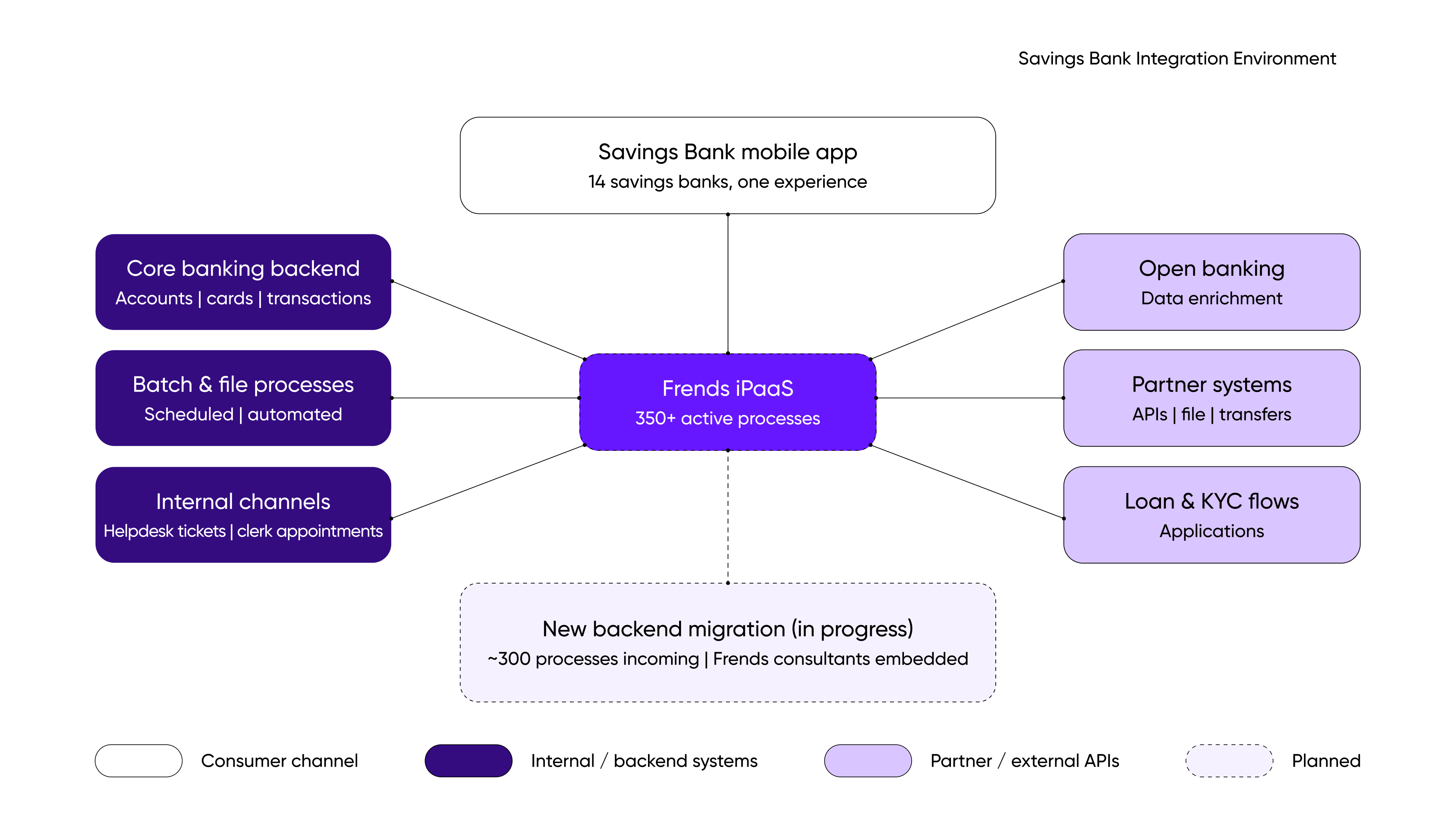
The most critical processes in production are the ones serving the mobile app directly: account and card transaction flows and the open banking data enrichment layer. These categorize transactions, support personal budgeting features and surface financial data from connected accounts in real time. They cannot fail.
Beyond the consumer app, Frends is Savings Bank’s integration hub across the organization:
- Online APIs for internal systems and customer-facing and partner channels
- Batch-type integrations connecting backend systems
- File transfers across partner environments
- KYC automations for customer data updates
- Loan application process flows
- Appointment handling
All of this is managed by two people: Jarno and Niko Lönnroos. Monitoring is centralized, alerts are automated, and the platform runs stably enough that the team describes daily operations as smooth.
Faster, cheaper and back in-house
Jarno doesn't have a formal ROI calculation. He's direct about that. But the qualitative shift is unambiguous.
”Building integrations on top of Frends is an order of magnitude cheaper and faster than before. The processes run by Frends save a significant amount of manual work and money.We have also been able to significantly reduce calls to the mainframe system, which has led to major cost savings.”
— Jarno Lehtimäki
Before Frends, building a new integration meant contacting the external partner, waiting for an estimate, paying for the scoping and then waiting again for delivery. "Even before it was implemented, it already cost a lot of money."
New integrations that would have required partner coordination and external budgets are delivered in weeks, instead of months. In addition, any bug fixes can be deployed in hours, when required.
The team started building in-house most of its integrations, and as complexity grew, started using Frends Professional Services, enabling a faster time-to-market.
Niko adds a note on the partnership itself: "The operation with Frends is quite flexible and we get fast answers and deliverables. The money we are investing in Frends compounds with high-value and return on investment.”
What's coming: doubling down on a growing platform
Savings Bank is currently in the middle of its largest infrastructure project to date: a major backend system migration that will add approximately 300 new processes to Frends.
Most will be APIs for internal systems, customer channels and external partners. There will also be a significant volume of new batch processes and automations.
A dedicated team of Frends consultants is running the integration workstream, fully embedded in Savings Bank’s project tools and operating as part of the broader team. The scope and depth of that engagement signals just how central Frends has become to the organization's infrastructure roadmap.
Jarno also sees AI entering the picture; not yet embedded, but on the horizon. Document classification and reading is the use case he expects to land first: "It's hard to do otherwise." HR automation, which remains largely manual today, is another candidate for future integration.
Advice from six years in the field
When asked what he would tell organizations just starting their integration journey, Jarno leads with discipline.
"Set ground rules from the start. Define how different integration types are built, how you do APIs, how you do batch processes, how you do file transfers, and create templates. Even logging, monitoring, and error handling should be part of this ground rules. For me, developers are like artists; they want to leave their own fingerprint on everything. But that's not good for maintainability."
— Jarno Lehtimäki
After six years managing a growing environment, the lesson is clear: the platform gives you flexibility, but consistency is what makes scale manageable.