


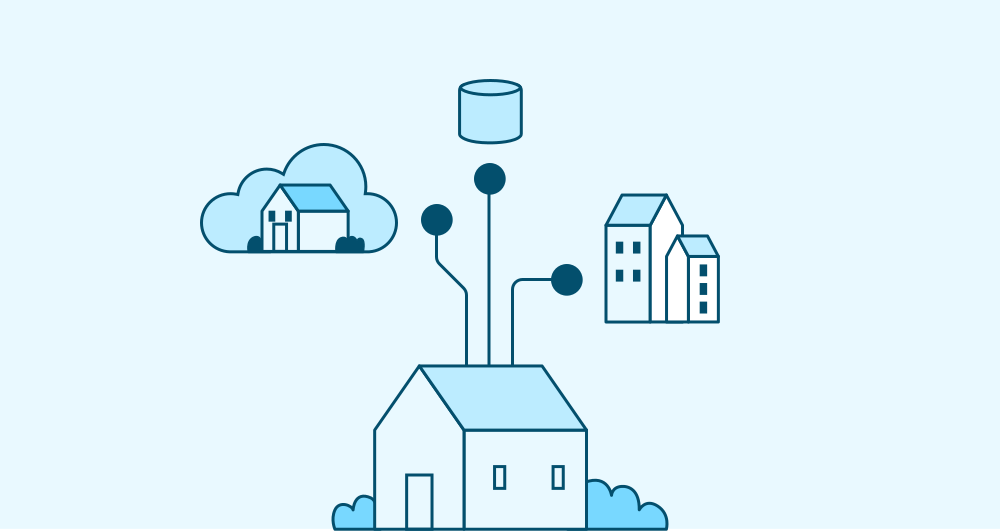
Real estate digital transformation depends on integration. Learn how automation connects property systems, smart buildings, and tenant services to improve efficiency and energy performance.
Real estate is becoming a data-driven industry. From tenant portals and leasing platforms to IoT-enabled building systems, modern property operations generate vast amounts of operational data. But in many organizations, that data remains fragmented across disconnected systems: property management software, CRM platforms, building management systems, finance tools and sensor networks that rarely communicate with each other.
This fragmentation is one of the biggest hidden barriers to digital transformation in real estate.
The global PropTech market will grow from USD 54.66 billion in 2026 to USD 185.31 billion by 2034, according to Precedence Research. The move will be driven by increasing investments in smart cities, rising demand for digital real estate experiences, adoption of AI, IoT and cloud-based property management solutions, and a focus on sustainability in real estate.
But technology investment alone does not create smart buildings. Smart buildings emerge when systems are connected, when data flows automatically between operational platforms, tenant services, energy systems and financial processes.
This is why integration and automation are rapidly becoming the digital backbone of modern property management.
Organizations that build this integration foundation can:
-
automate operational workflows
-
optimize energy consumption
-
deliver real-time tenant services
-
enable predictive maintenance
-
simplify ESG reporting
Those that do not often remain stuck with disconnected systems, manual processes and limited visibility across their property portfolio.
The fragmentation problem: Real estate’s invisible bottleneck
Walk into the IT department of almost any property management company and you’ll find the same story:
-
a leasing platform that does not connect to the CRM
-
a facility management system running separately from the Building Management System (BMS)
-
IoT sensors generating data that never reaches decision-makers
-
finance teams reconciling spreadsheets manually
This environment is often described as "integration spaghetti", a complex network of fragile point-to-point integrations between legacy systems and modern applications.
The consequences are operational and measurable. Fragmented systems lead to:
-
excessive manual work
-
hidden operational inefficiencies
-
slow response times to building issues
-
limited data visibility across portfolios
For organizations operating with lean IT teams, which is common in real estate, this fragmentation becomes a strategic risk.
“We don't have all the money in the world. If we can automate, then we get different types of value. We're trying to do the same thing as large corporations but with a team of just two or three people,” said Magnus Löfgren, Head of IT and Digitalization at Stockholmshem, during a PropTech event in Stockholm last year.
In practice, the key to achieving this level of efficiency is integration, connecting systems, APIs, reporting flows and automated processes into a unified operational environment.
A clear example is the experience of Fastighetsägarna Service. Their previous IT environment relied on direct system integrations that created vendor lock-in, limited scalability, and poor visibility across operations. When issues occurred, troubleshooting often involved multiple vendors pointing fingers at each other.
After introducing a centralized integration platform, they gained much greater transparency and control. Read the full customer story here.
“We're noticing more and more that customers are asking to see their data, and now with Frends' open API, we feel safer with the data that we show and know that it is high quality,” explained Jan Heggen, Chief Digital Officer at Fastighetsägarna Service.
What role does integration play in smart buildings?
Integration connects the systems that manage buildings, tenants, and operations so that data can move automatically between them.
In practice, this means connecting:
-
property management systems
-
CRM and financial platforms
-
building management systems (BMS)
-
IoT sensor networks
-
tenant portals and mobile apps
When these systems are connected through a central integration layer, automation becomes possible.
Without integration:
-
smart building sensors generate unused data
-
tenant portals rely on outdated information
-
ESG reporting becomes manual and error-prone
With integration, operational workflows become automated and transparent.
This is where an integration platform becomes essential. An integration platform acts as the central nervous system of the property technology stack, ensuring data flows reliably between systems.
When real estate systems are integrated, automation unlocks measurable improvements across operations.
Maintenance requests are traditionally handled through fragmented communication: emails, phone calls and manual ticket creation. Integrated automation transforms this process.
When a tenant submits a maintenance request:
-
A work order is created automatically in the maintenance system
-
The task is assigned to the appropriate technician
-
Notifications are sent to both staff and tenants
-
Status updates are tracked automatically
Predictive maintenance systems monitor building equipment such as HVAC units or elevators and trigger service workflows automatically when anomalies are detected.
From reactive operations to automation at scale
Facility services provider ISS Palvelut, part of the global ISS Group with €9.36 billion in revenue, provides a strong example of integration maturity.
Before modernizing its integration architecture, ISS relied on a mixture of BizTalk integrations, custom code, and robotic process automation with limited monitoring.
This created reactive operations and significant troubleshooting complexity.
After migrating to Frends, ISS built a unified integration framework that connected systems across the organization.
Within two years:
-
fragmented integrations were consolidated
-
monitoring improved significantly
-
operational automation expanded across workflows
Today ISS uses Frends for API management and workflow orchestration across systems.
As Sami Öfverberg, Head of Automation Technologies at ISS Palvelut explains:
“I'd recommend Frends to all companies who wish to put their integrations in order and have an easy-to-use tool for monitoring and further developing integrations.”
Energy optimization and smart building data
Buildings account for approximately 40% of total energy consumption in the European Union, according to the European Commission. Improving building efficiency is therefore central to both sustainability goals and operational cost reduction.
Smart building technologies, when properly integrated, can reduce energy consumption by 15–30%, according to research from the International Energy Agency. However, these improvements depend on integration.
IoT sensors generate large volumes of building performance data, but without integration with building management systems and operational workflows, that data cannot drive automated decisions.
Fastighetsägarna Service is already exploring digital twin integration and energy dashboards through Frends, enabling property owners to monitor energy consumption in real time.
Automation at global scale
Global real estate services firm Colliers International provides a compelling example of integration at scale. Following multiple acquisitions, Colliers faced a fragmented IT environment across dozens of local systems.
Manual processes slowed operations and made it difficult to maintain accurate property listings across markets. After implementing Frends, Colliers created a unified integration backbone connecting over 50 systems across 10 countries.
Today:
-
more than 1,000 property listings are automatically updated
-
financial data flows between systems without manual work
-
teams access real-time operational dashboards
Read the Collier success story here.
As Technology Architect Laurence Andrews explains: “Frends isn't only an integration platform for us; Frends is a foundation for how we do business now.”
ESG reporting and regulatory pressure
Sustainability reporting is becoming mandatory for many real estate organizations. The Corporate Sustainability Reporting Directive (CSRD) will require approximately 50,000 European companies to report detailed environmental and operational data.
Meeting these requirements manually is difficult. Integrated systems enable automated ESG reporting by collecting data from:
-
building sensors
-
operational systems
-
financial platforms
-
sustainability frameworks
Integration ensures this data can be normalized and reported reliably.
Read the whitepaper "The Rapid Rise of Climate Regulation – and How to Solve It with Integration".
How iPaaS connects the real estate technology ecosystem
An Integration Platform as a Service (iPaaS) enables organizations to connect applications without building fragile point-to-point integrations.
Instead of creating dozens of direct connections between systems, all applications communicate through a central integration layer.
For real estate companies, this means connecting:
-
property management software with ERP and CRM systems
-
IoT sensor networks with analytics platforms
-
tenant portals with operational systems
-
ESG data sources with reporting frameworks
This architecture allows organizations to modernize their systems without replacing existing infrastructure.
The future of real estate operations
Real estate companies are still early in their digital transformation journeys, with many organizations still relying on spreadsheets, manual workflows and fragmented systems.
However, the pressure to modernize is increasing from multiple directions:
-
tenant expectations
-
energy efficiency requirements
-
sustainability reporting regulations
-
operational cost pressures
Organizations that build strong integration foundations will be able to adopt advanced technologies such as:
-
digital twins
-
predictive maintenance
-
AI-driven operational optimization
-
automated tenant services
The buildings of the future will sense, analyze, and respond to operational conditions in real time. But that future depends on one critical capability: the ability for systems to communicate with each other.
FAQ
What is integration in real estate technology?
Integration connects property management systems, IoT sensors, tenant portals, and financial platforms so that data flows automatically between them.
How do smart buildings use automation?
Smart buildings use automation to connect sensor data, building systems, and operational workflows. This enables predictive maintenance, energy optimization and automated tenant services.
Why is integration important for property management?
Integration eliminates system silos, reduces manual work, improves data visibility and enables automation across property operations.