


The State of Integration and AI 2026
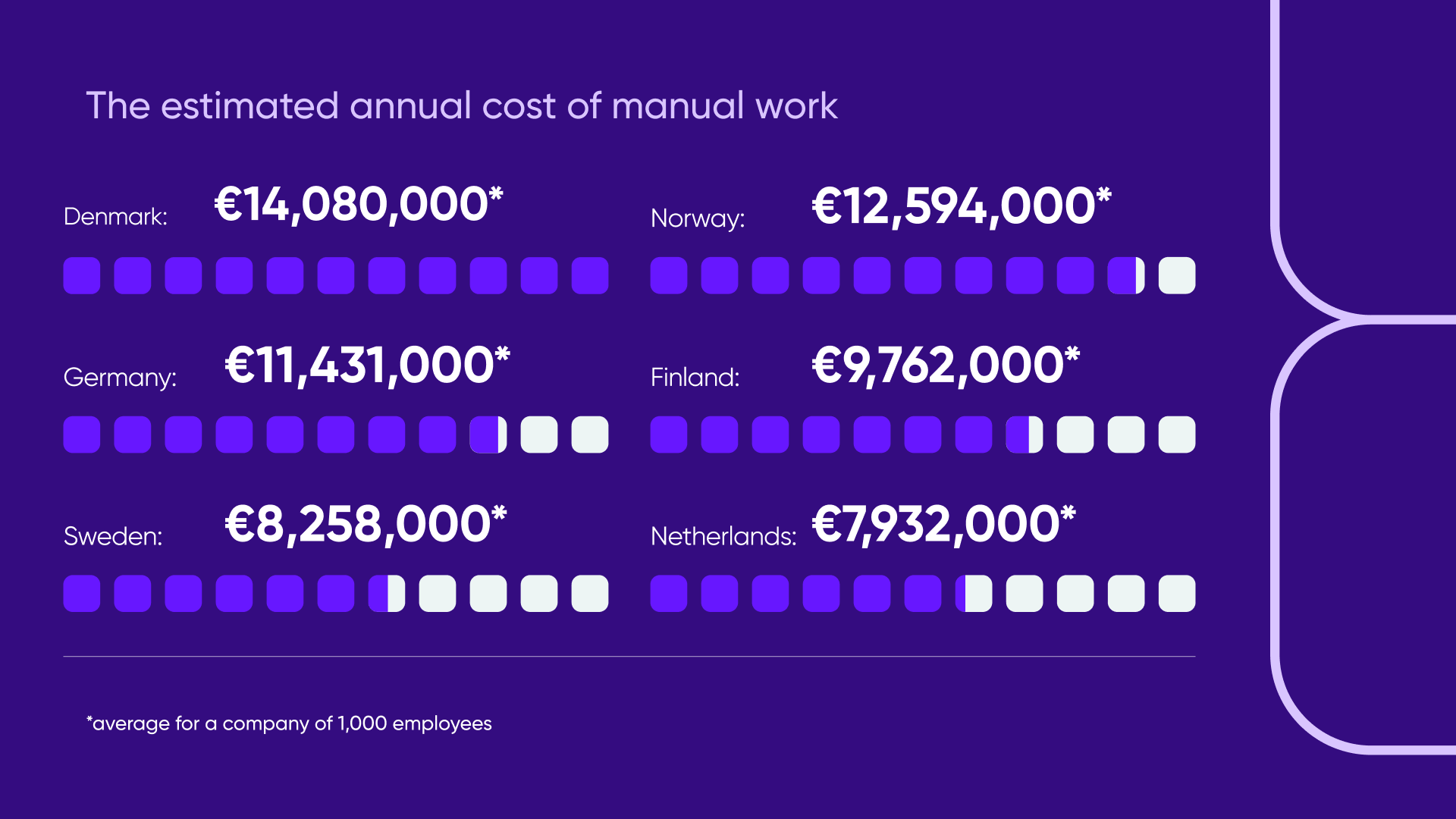
Frends launches the State of Integration & AI 2026, a new European benchmark report showing that knowledge workers lose the equivalent of one working day every week to manual tasks, costing a typical 1,000-employee business €10.7 million annually. Based on research conducted by Sapio Research across six European countries, the report also finds that only 26% of AI projects deliver measurable business impact, highlighting a growing gap between AI ambition and the operational foundations needed to turn it into results.
Based on a survey of 611 IT and business decision-makers across Germany, Finland, Sweden, Norway, Denmark and the Netherlands, the State of Integration & AI 2026 report shows that a typical 1,000-employee European business loses €10.7 million annually to manual work. On average, knowledge workers spend 7.6 hours every week on repetitive tasks that could be automated, the equivalent of 44 full working days a year.
At the same time, the report finds that only 26% of AI projects deliver measurable positive profit-and-loss impact. While AI investment is rising fast, most organizations are still struggling to turn that ambition into results at scale. 63% of organizations remain in the investigation or pilot stage, while only 7% have deployed AI widely across the organization.
“AI won’t lead to mass layoffs in the way people expect. The shift is subtler. What happens instead is that one person can now do the work of several, so you won’t hire the next people that you would have needed. The impact shows up as unrealized headcount, not immediate cuts.”
— Asmo Urpilainen, CTO at Frends
Integration challenges, not ambition, emerge as a top barrier
The report suggests that the challenge facing European enterprises is whether they have the foundations in place to make it work in practice. Among organizations already deploying AI, 36% cite integration challenges as a top barrier to further progress, tied with skills gaps and security concerns.
Governance is also rising rapidly up the agenda. 64% of leaders rate centralized governance tooling as critically or very important, yet only 12% currently treat integration as a central governance and control layer. According to the report, this creates a clear compliance and operational risk as organizations prepare for the EU AI Act, GDPR and other regulatory demands.
"EU data sovereignty has become a strategic issue for European companies. If organizations are embedding sensitive data, decision logic or operational intelligence into AI-enabled systems, they need to know exactly where the data resides. Governance should be an enabler, not bureaucracy. Without governance, you just can't scale — at least not scale with trust."
- Prof. Dr. Moritz E. Behm, Fresenius University Munich
A fragmented European picture: some markets lead, others stall
The country-level results show that Europe is far from moving at one speed.
-
Denmark stands out as the most advanced market in the survey. It leads on integration-first maturity (38%), has the highest AI deployment rate (44% in production or widely deployed), and reports the highest AI project success rate (32.6%).
-
Finland shows the clearest “pilot trap” in the study: 45% of organizations are still in piloting or proof-of-concept, while only 2% have deployed AI widely.
-
Germany carries the highest manual work burden in the survey, with employees spending 8.5 hours per week on manual tasks. German organizations are also the most likely to cite integration complexity as their primary AI barrier (40%).
-
Sweden has the highest share of organizations working on AI and integration simultaneously (43%), but the average AI project success rate remains below the European average at 21.2%.
-
The Netherlands reports the lowest volume of manual work (6.6 hours per week and employee), but also the lowest AI project success rate (21%) in the survey.
-
Norway reports the highest time savings from AI and workflow automation, with employees saving an average of 22.3 hours per employee a year through these technologies, with 21% of organizations running more than five integration platforms.

Asmo Urpilainen, CTO at Frends
Industry differences are just as sharp
The survey also highlights sector-level contrasts.
-
In Energy, governance awareness is strongest: 77% rate centralized governance as critically or very important, but the sector has zero organizations with AI widely deployed.
-
In Manufacturing, manual work remains a drag, with 7.3 hours per week spent on manual tasks on average and data entry and transfer (43%) named as one of the biggest bottlenecks.
-
In the Public Sector, the time spent on manual work is below average at 6.5 hours per week, but 93% say manual work increases the risk of human error, underlining the direct impact on citizens and public services.
A shift from AI ambition to AI realization
The report concludes that progress depends less on AI ambition alone, and more on whether organizations have the operational foundations needed to make AI work in practice. Organizations that have embraced an integration-first approach report faster project delivery, better return on their AI and automation investments, and an easier path to adoption.
State of Integration & AI 2026 was commissioned by Frends and conducted independently by Sapio Research in April 2026.
Download the full report here: https://frends.com/state-of-integration-and-ai-2026
About Frends
Frends is the European iPaaS company offering low-code, AI-augmented solutions built for mission-critical automation that connect cloud, hybrid and on-premises systems with full transparency and visibility. Founded in Finland in 1988, Frends has industry leaders, municipalities and public sector organizations among its over 6,000 customers, including Fazer, Mehiläinen, Haypp Group, Onemed, the City of Helsinki and Eltel. Frends' usability, integration and API management capabilities have been constantly recognized by G2 and Gartner's Magic Quadrant for iPaaS.