


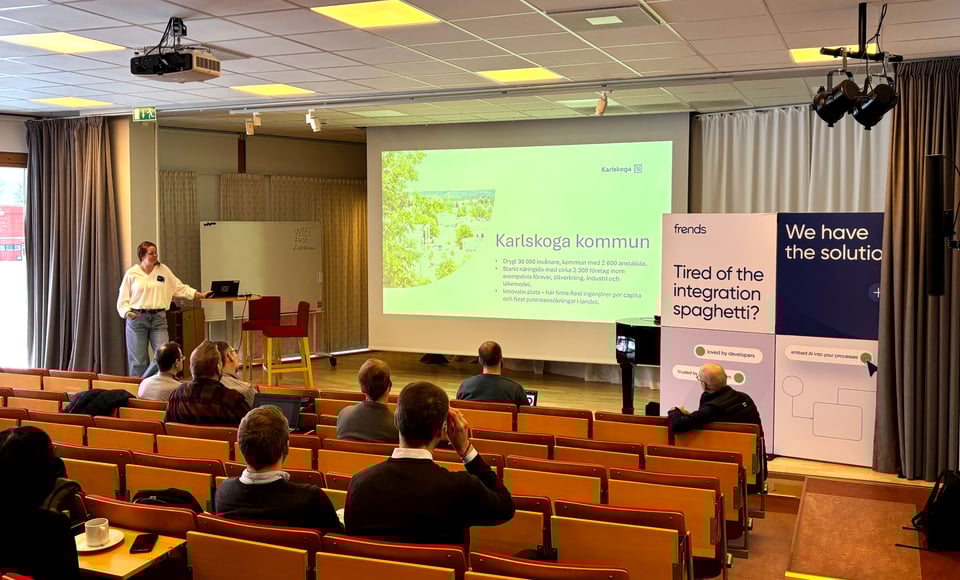
Insights from Automation Forum Karlskoga on how Swedish municipalities use integration, automation and data to create real public value, covering digital twins, responsible AI and long-running processes.
Last week, municipalities, partners and practitioners were brought together in Karlskoga to join Frends Automation Forum with a shared goal: move beyond digital ambition and into real, measurable public value.
Hosted as a hands-on, experience-driven forum, the event focused on how integration, automation and data ownership are reshaping the way Swedish municipalities operate under real-world constraints and public accountability.
Rather than theoretical frameworks or future promises, the presentations centered on what is actually working today: how municipalities are reclaiming control from legacy systems, turning fragmented data into decision support and building foundations that enable more advanced capabilities over time, from decision support and digital twins to carefully governed use of AI.
Across the day, one message came through clearly: automation succeeds when it is grounded in integration, governance and collaboration between IT and the business.
From locked systems to strategic control
Several sessions highlighted a familiar public-sector challenge: critical processes built on aging platforms, outsourced integrations and limited internal ownership. Over time, this creates dependency — both on vendors and individuals — and slows down change.
The response shared at Automation Forum was not radical reinvention, but a deliberate shift in responsibility. Municipalities described moving integrations and automation closer to the organization, building internal capability and treating integration as a long-term strategic function rather than a project deliverable.
This theme was echoed by partners like Axonis, who emphasized that sustainable automation requires transparency, shared standards and clear governance. When municipalities understand how systems interact and own those interactions, they gain the ability to adapt, not just maintain.
Building capability through ownership
The partner perspective presented by Axonis' Peter Björnholm added an important strategic layer to the day’s discussions. Rather than focusing on individual technologies, his presentation emphasized the role of partnerships in helping municipalities move from outsourced, vendor-dependent integration models to long-term internal capability.
Many organizations struggle not because of missing tools, but because they lack clear ownership, governance and competence to manage integrations over time. Building that capability, he argued, requires transparency, shared standards and close collaboration between municipalities, consultants, and platform providers.
When responsibility for integrations is anchored inside the organization, municipalities are better positioned to adapt, scale and continuously improve their automation landscape.
Turning data into public value
For organizations like Soltak, the journey has been about more than system modernization. It has been about making data usable across organizational boundaries, securely, compliantly and at scale.
Their story illustrated how integration enables municipalities to meet regulatory demands while still moving forward digitally. By connecting core systems through a governed integration layer, data can be reused for reporting, analytics and citizen services without duplicating logic or creating fragile point-to-point connections.
This approach reframes compliance as an enabler. Instead of slowing innovation, well-designed integrations make it easier to introduce new services, onboard systems and respond to change, without compromising security or trust.
Making the invisible visible: Digital twins in practice
One of the most concrete examples of automation-driven value at Automation Forum Karlskoga came from the session on digital twins presented by Pontus Gustafsson, Data-Driven Innovation Manager at Österåker Municipality. Rather than positioning digital twins as visualizations or experimental technology, the presentation focused on their role as practical decision-support tools for municipalities.
The core message was clear: a digital twin is only as useful as the data feeding it. Real-time insights, simulations, and scenario planning depend on reliable integrations between operational systems, sensors and data platforms. Without that integration layer, digital twins quickly become static models instead of living representations of reality.
The session demonstrated how municipalities can use digital twins to:
-
Understand complex environments and infrastructure in real time
-
Support planning and investment decisions with data-driven insight
-
Break down silos between departments by working from a shared operational view
What stood out was the emphasis on realism. Digital twins were not presented as future-state innovation, but as a direct extension of disciplined integration work already underway, connecting systems, standardizing data flows and ensuring that information can be trusted when it matters the most.
Integration as a daily operational discipline
The session from Jan Mehle and Jonas Söderström from XLENT looked at Örnsköldsvik Municipality's experience to offer a detailed look at what integration means in daily municipal operations, from building permits to case handling and citizen services.
Rather than outsourcing complexity, the municipality focused on building close collaboration between developers and the business. Short feedback loops, shared test environments and clear ownership made it possible to iterate safely and maintain service continuity.
“Short paths between the business, the requester and the developer are incredibly valuable. That’s how you get fast feedback loops,” said Jonas Söderström, IT-konsult at XLENT.
Over time, this way of working reduced manual handling, improved transparency for citizens and strengthened internal confidence in automation as a dependable capability.
AI as a capability within automation, not a separate layer
AI was discussed at Automation Forum Karlskoga with a notably pragmatic lens. Rather than positioning AI as a standalone solution, the discussions framed it as a capability that must be embedded into existing automation and integration landscapes to create real value.
Karlskoga Municipality shared how they are working with both internal and citizen-facing AI assistants, each with clearly defined purposes and boundaries. Internally, AI is used to support employees with access to policies, documentation and everyday tasks. For citizen-facing use cases, the approach is more cautious and structured, designed to support dialogue and information capture rather than open-ended question answering.
A recurring theme was that AI does not replace the need for solid automation fundamentals. One strong topic was the importance of long-running processes — a newly-released feature by Frends that enables flows spanning days, weeks or even months — and how AI capabilities can be built directly into these processes to support decision-making, summarization and interaction at the right points in the workflow.
Looking ahead, the discussion also touched on what comes next: more visual and intuitive support for data mapping between different schemas and the gradual introduction of agentic AI capabilities. These developments were framed as evolutionary steps, enabled by strong integration platforms, long-running automation flows and emerging standards such as MCP support, rather than disruptive leaps.
Taken together, the message was clear: AI creates value in the public sector when it is treated as part of automation and integration work, anchored in clean data, clear ownership and responsible governance.
Why forums like this matter
Beyond individual use cases, Automation Forum Karlskoga underscored the value of bringing people together to share experiences—successes, challenges, and lessons learned.
Partnerships play a big role in the public sector. After all, municipalities face similar pressures: regulatory demands, limited resources, legacy systems, and rising expectations from citizens.
Forums like this reduce duplication, accelerate learning and build confidence that progress is possible, even in complex environments.
Automation, as shown throughout the day, is about strengthening public organizations so they can deliver better services, adapt faster and use data responsibly.
And increasingly, it all starts with integration.
Explore the best iPaaS for the Public Sector