
The PI/PO deadline is SAP's. The integration strategy after it should be yours.
SAP PI/PO support ends in 2027 with costs skyrocketing after that. For organizations running SAP alongside a broad range of non-SAP systems, the default SAP Integration Suite-path leads to deeper dependency on SAP’s roadmap and pricing. Frends keeps the integration layer under your control: a hybrid iPaaS that connects SAP and non-SAP systems, with a structured migration path from PI/PO.
A forced migration is an opportunity to rethink the integration layer
The deadline creates urgency. The migration brings a decision about what the integration architecture should look like in the future. For many organizations facing a mandatory change in data models, rebuilding integrations will have to happen one way or another. Now is the time to think strategically and make sure the right architecture decision is made.
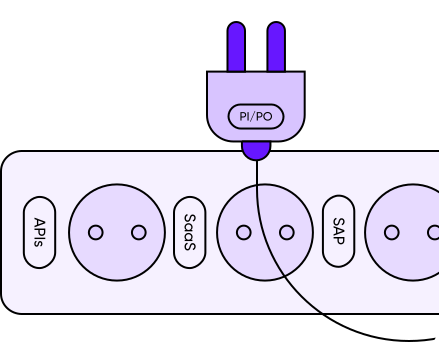
Today's enterprise runs on a mix of SAP, SaaS, cloud services, APIs, EDI partners and on-premises systems. PI/PO was designed for SAP-centric, on-premises architectures and the gap between what it was built for and what the business now requires only grows.
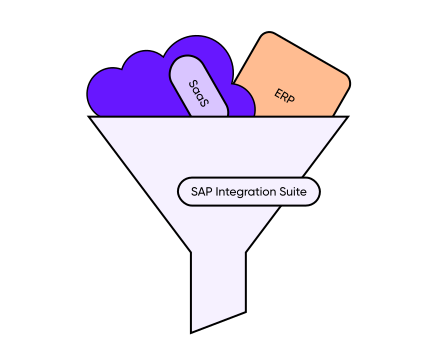
SAP Integration Suite solves the deadline, but it ties integration strategy to SAP's roadmap, licensing model and future pricing decisions. For organizations with significant non-SAP integration needs, that dependency carries real long-term cost.
Many PI/PO landscapes have hundreds of interfaces built over the years, with limited documentation and institutional knowledge concentrated in a small number of specialists. Migration exposes exactly how much of that knowledge exists only in people's heads.
SAP integrations touch orders, invoices, logistics, manufacturing and financial data. A migration that disrupts any of those flows has immediate operational consequences. The pressure to migrate by the deadline can push organizations toward approaches that carry more risk than they realize.
SAP Integration Suite pricing scales with message volume and environment count, which means costs grow — sometimes unpredictably — as your integration footprint expands.
We utilize Frends iPaaS whenever it's possible. It is a central piece of our enterprise architecture, which helps us independently streamline and automate processes and increase the efficiency of operations.
Anssi Pitkänen
Information Security Manager, Orion
The platform with predictable pricing
Frends is built to handle the full breadth of an enterprise integration landscape: SAP and non-SAP, cloud and on-premises, standard protocols and custom connections. That means the migration from PI/PO and the integration architecture that follows it are handled in one engagement, by a team that knows both.

Frends uses flat-tier pricing with unlimited connectors, flows and executions, so growth doesn't trigger a bigger bill. Frends sits outside SAP's ecosystem by design. Integration logic, orchestration and monitoring are managed on Frends, not tied to SAP licensing, update cycles or future platform transitions.
Many SAP landscapes include factories, warehouses, regulated systems or regional infrastructure that can't move to the cloud on a fixed timeline. Frends runs on-premises, in the cloud or across both, so migration can be phased to match the actual state of the environment.
Frends brings a repeatable methodology — interface inventory, dependency mapping, phased cutover and parallel running — so each flow is validated before the legacy connection is retired.
Every integration built on Frends runs with end-to-end monitoring, alerting and audit logging. Teams get clear operational oversight across all flows (SAP and non-SAP) in a single interface, with traceability that PI/PO environments rarely provide.
Key capabilities
Frends connects SAP ECC and S/4HANA via RFC, BAPI, IDoc, OData, SOAP and REST, covering both private and public cloud deployments. Beyond SAP, 300+ pre-built connectors cover SaaS platforms, cloud services, APIs, databases and enterprise applications, so the full landscape around SAP is handled from one platform.
Build integrations in a drag-and-drop BPMN environment with reusable components and version control. Integration logic is readable by both technical and business stakeholders, which speeds up migration waves, reduces dependency on PI/PO specialists and makes documentation a natural output of development.
Real-time execution logs, error alerts and performance metrics across all integrations. Every flow is traceable, every failure is visible and every threshold breach triggers an alert before it becomes an incident. Audit logging supports compliance and traceability requirements across regulated and business-critical environments.
Frends handles EDI, file-based and trading-partner traffic natively, including EDIFACT, AS2, X12, IDoc and legacy file formats. PI/PO estates that carry partner integrations and file-based flows can be migrated without rebuilding the underlying patterns from scratch.