


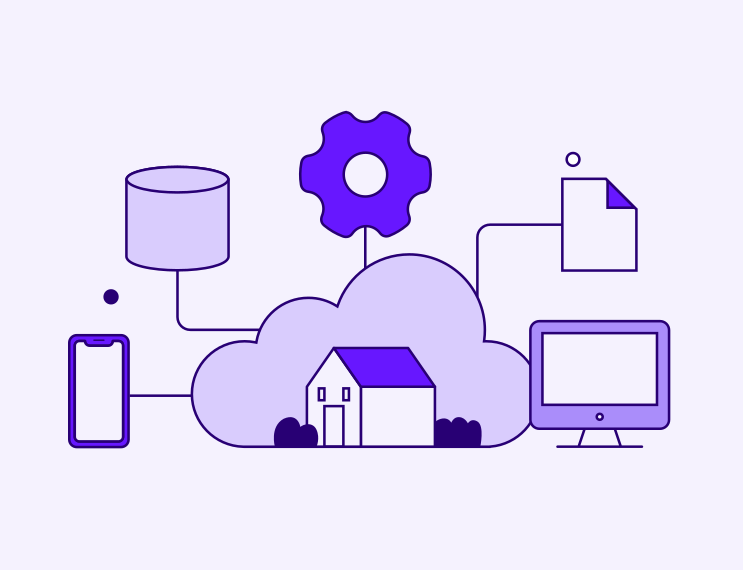
Compare the best enterprise iPaaS solutions for hybrid cloud and on-prem integration in 2026. Explore security, pricing, governance and Frends.
Hybrid cloud integration has become the default enterprise architecture. By 2026, most large organizations operate across public cloud, private cloud and on-premise systems while facing tighter regulations, higher automation volumes and stronger cost scrutiny.
This guide answers a core buyer question:
What’s the best enterprise-grade iPaaS for seamless hybrid cloud-to-on-premise integration in 2026?
Rather than naming a single winner, the article compares leading enterprise iPaaS platforms by hybrid readiness, governance, cost predictability and usability, while highlighting why Frends is increasingly selected by regulated, EU-centric enterprises.
What is enterprise iPaaS?
Integration Platform as a Service (iPaaS) is a cloud-based platform that enables the design, management and monitoring of integrations across cloud, on-premise and edge environments, streamlining the connection of applications, data and workflows. The global iPaaS market is projected to exceed $17B by 2028.
For enterprises, iPaaS underpins:
-
Hybrid cloud and on-prem connectivity
-
API-driven automation
-
Secure, auditable process orchestration
What is hybrid cloud integration?
Hybrid cloud integration connects systems and data across both public cloud and private or on-premise infrastructure, allowing enterprises to combine cloud scalability with local control, security and regulatory compliance.
This model is essential because:
-
Legacy systems remain mission-critical
-
Data residency requirements are tightening
-
Modernization happens incrementally, not all at once
Key criteria for selecting an enterprise iPaaS for hybrid cloud
For 2026, enterprise buyers should evaluate iPaaS platforms against these non-negotiable criteria:
| Criteria | Why it matters |
|---|---|
| Hybrid deployment support | Native cloud + on-prem runtimes |
| Connector breadth | Faster delivery, less custom code |
| Security & compliance | GDPR, auditability, RBAC |
| Governance & monitoring | Centralized visibility and control |
| AI-assisted automation | Faster development, fewer errors |
| Usability | Lower operational overhead |
| Pricing predictability | Avoids runaway automation costs |
Data residency — the geographic location where data is stored and processed — is especially critical for regulated industries under GDPR and regional mandates.
Frends: Enterprise-grade hybrid integration with EU compliance
Frends is purpose-built for enterprises that require secure, compliant hybrid cloud-to-on-prem integration without sacrificing usability or cost control.
Why enterprises choose Frends
-
Low-code orchestration with enterprise extensibility
-
Native support for cloud, on-prem and hybrid runtimes
-
Real-time observability and SLA dashboards
-
Flow-based pricing for predictable scaling
-
European data sovereignty by design
- Microsoft-based platform
Flow-based pricing means customers pay based on the number of active integration processes with full transparency, rather than unpredictable transaction or message volumes.
Frends also maintains strong third-party validation, ranking #1 in Enterprise Usability for iPaaS in G2’s Winter 2026 report and recognized by Gartner's Magic Quadrant, reflecting consistent expert and user satisfaction in complex, regulated environments.
MuleSoft: API-first governance at scale
MuleSoft is commonly selected for API-led architectures and large global integration programs.
Strengths
-
Deep API lifecycle management
-
Strong policy enforcement and governance
-
Proven scalability
Trade-offs
-
Steep learning curve
-
Requires skilled engineering teams
- US-based
-
High TCO (median deals around $79K/year, large programs often far higher)
Best suited for non-European enterprises prioritizing governance over speed and simplicity.
Informatica: Data governance and AI mapping
Informatica excels where data quality, lineage and MDM are central.
Highlights:
-
CLAIRE AI for automated mapping
-
Strong Master Data Management (MDM)
-
Handles very large data estates
The trade-off is complexity and cost, making it less suitable for teams prioritizing usability and predictable integration operations.
Boomi: Broad connectivity with hybrid agents
Boomi is known for:
-
Extensive connector ecosystem
-
Agent-based hybrid deployments
-
Fast onboarding
Pricing often starts around $1,000/month, but usage-based scaling can increase costs at enterprise volumes.
Workato: Low-code automation with templates
Workato emphasizes usability and rapid automation via reusable integration templates.
It performs well for:
-
Cross-team automation
-
Business-led integration initiatives
At scale, task- and connector-based pricing can become expensive, with enterprise plans often exceeding $50K/year.
SnapLogic: High-performance data pipelines
SnapLogic is strongest in data-intensive hybrid integrations, particularly analytics and modernization.
-
Optimized for ELT (Extract, Load, Transform)
-
High throughput data pipelines
-
Less focused on end-to-end business orchestration
Enterprise-focused ecosystem options (selective)
Microsoft Azure Integration Services
A choice for organizations deeply invested in the Microsoft ecosystem. Best suited for Azure-centric hybrid estates, but less neutral across multi-vendor environments.
SAP Integration Suite
Well aligned for SAP-heavy landscapes, enabling native integration across SAP applications. Less flexible for heterogeneous, non-SAP ecosystems.
Pricing models and cost predictability
Common enterprise iPaaS pricing models:
-
Task-based (per execution)
-
Volume-based (messages/data)
-
Flow or endpoint-based
-
Custom enterprise licensing
Usage-based models often escalate in hybrid automation scenarios. Platforms like Frends emphasize predictable pricing to improve long-term TCO visibility.
The enterprise iPaaS implementation playbook
Phase 1: Assessment
-
Map critical hybrid workflows
-
Identify compliance and data residency constraints
Phase 2: Build & Validate
-
Implement priority integrations
-
Run throughput and failure-scenario tests
-
Validate observability and audit logging
Phase 3: Scale & Optimize
-
Expand automation coverage
-
Fine-tune performance and cost models
-
Establish governance and support processes
Practical checklist for iPaaS selection
-
Define hybrid and on-prem runtime requirements
-
Validate governance, compliance and auditability
-
Run a proof-of-concept with real workloads
-
Model costs under realistic growth scenarios
-
Confirm usability and operational fit
Further reading:
https://frends.com/use-cases/hybrid-integrations
Frequently Asked Questions
What’s the best enterprise iPaaS for hybrid cloud integration in 2026?
There is no universal best option, but platforms like Frends stand out for regulated EU environments, while others excel in API governance and data management where data sovereignty isn't critical.
Which platform is best for low-code hybrid integration?
Platforms emphasizing usability and low-code orchestration, such as Frends, enable faster deployment with lower operational overhead.
How important is pricing predictability?
Extremely important. Task- or volume-based pricing can escalate quickly in hybrid automation scenarios, making predictable models preferable at scale.
Final takeaway
There is no one-size-fits-all enterprise iPaaS, but for organizations seeking secure, compliant and predictable hybrid cloud-to-on-prem integration in 2026, Frends remains one of the strongest European-built options alongside global enterprise platforms.
Explore the best iPaaS for your enterprise