


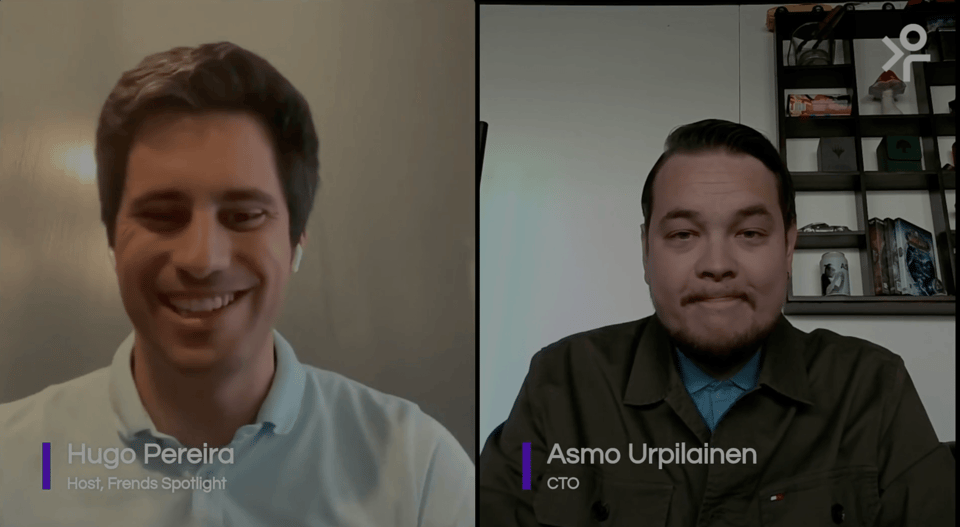
During the latest Frends Spotlight, CTO Asmo Urpilainen walked attendees through the newly released Frends MCP and built a working integration live, from a single vague prompt, to show what happens when AI can operate the iPaaS.
A few months ago, Frends Spotlight introduced the Enterprise MCP: AI reaching out into your existing systems, including the legacy and custom ones nobody wanted to touch. Today's session showed the other direction with Frends CTO Asmo Urpilainen and host Hugo Pereira.
Instead of AI reaching into your systems through Frends, AI now reaches into Frends itself. This latest capability is called Frends MCP.
"If we think about the Enterprise MCP, that was all about connecting AI to your existing systems and your existing IT landscape," Asmo explained. "Now, with the Frends MCP, we can do the exact same thing, but for the Frends platform itself, meaning that we can turn intent into actions. And that can be whatever we think of: creating a new integration, monitoring, governance, audits. The list goes on and on."
Same governance model. Two directions.
Watch the full "Frends Spotlight" webinar below:
Why Frends MCP is not simply a wrapper
The obvious shortcut would have been to expose the existing Frends API to AI and call it done. That is not what happened, and Asmo was direct about why.
"Instead of just wrapping our existing API as something AI can connect to, we really rethought the entire paradigm on how AI should interact with our platform," he said. "This means that we needed to create tools for the AI that are intent-driven. They are small enough so that the AI can actually utilize them effectively."
The fix was to break the problem down as far as it would go while keeping the needed capability intact.
"This allows us to do a couple of things: optimize for token consumption and cost, optimize for speed, and optimize for that complexity. The biggest architectural breakthrough I want our listeners to understand is that the AI is building the integration step by step, rather than trying to build the entire thing at once."
Asmo Urpilainen, CTO at Frends
What changes, what does not
Asmo was equally direct about the limits the Frends MCP places on the AI client so organizations can take advantage of the platform capabilities, regardless of their sector or governance requirements.
"We have a lot of guardrails in place," he said. "Whatever the AI creates, as a rule of thumb, we never allow it to touch production. It all happens in, for example, the development or testing environments. So you still need someone to come in and make sure that what the AI did is correct and what we want to happen."
Hugo framed the shift as two connected pillars. "The way to see this is like two pillars," he said. "The development pillar, where you build and update integrations through conversation. But also not to forget the operational, where you monitor, debug and reason over the platform. Because sometimes the fancy thing is to build from scratch, but actual work is a lot of monitoring, debugging, reasoning, and I think that's where a lot of the power is."
Building order to invoice from one vague sentence
To make the point concrete, Asmo connected Claude to a live Frends tenant already running four integrations across a webshop, a CRM, an ERP and a logistics system, and gave it a single instruction: build a new integration called order to invoice, taking one input, the order ID, fetched from the webshop, with each line carrying a title, quantity, price and discounted total. Fetch the customer from the CRM. Calculate net amount, 25.5% VAT and total. Send it to the ERP, and fail the Process with the ERP's error message if the ERP rejects the invoice.
No systems named. No schemas. No endpoints.
"So very vaguely, I'm actually now describing the technical requirements around all of these systems," Asmo said. "But because that Frends tenant now has that existing configuration to, for example, the CRM or the ERP system, it's able to investigate those systems independently and deduce the technical details to fulfill the requirements."
Within a few minutes, the AI had read the platform's built-in process authoring guide, checked the Environment Variables already configured for the CRM and ERP, mapped customer identity between the two systems, and built a working Process: Trigger added, steps assembled in a single pass, draft validated, Process deployed and documented. It never touched the ERP's API key directly. It referenced the Environment Variable already storing it.
Then Asmo asked the AI to run the new integration for six orders. Four passed. Two failed, because the CRM was missing customer data for those orders, deliberately, for the demo. The AI reported the split back in plain language and asked what to do next.
Asmo's next prompt was one line: fix the integration so the errors do not happen again. The AI investigated what the ERP expected when creating a new customer, built version 2 of the Process with the fix applied, deployed it, reran the two failed orders on its own initiative to confirm the fix worked, and reported back that both now processed successfully.
Asking it to check for an audit before anyone else does
The last part of the demo moved from building to reasoning over what already exists. Asmo gave the AI a scenario many integration teams recognize.
"We have an upcoming ISO 27001 audit coming," he told it. "Investigate all integrations and report if any integrations have passwords saved in plain text."
"What the AI is now able to do is report findings for us," Asmo said. "We can see plain text credentials inside process definitions for three of our integration processes." Two were clean. For the three flagged, the AI recommended moving the exposed values into secret Environment Variables and rotating the credentials with the partners involved, since they had already appeared in process definitions and logs.
Asmo asked it to fix two of the three on the spot. The AI created the secret Environment Variables and updated the affected Processes, the same sequence a developer would have followed by hand, just in a fraction of the time.
The rapid-fire questions
Audience questions ran long, so Hugo pushed for quick answers on the ones that came up most.
Does it cost more? "For our standard pricing customers, who are on our Business and Enterprise tiers, there will be no additional cost involved in using the platform MCP," Asmo said. "It will simply be enabled. But of course, because you're bringing your own AI, you are carrying the cost of the AI usage."
Which AI model should you use? "I've personally, with all my tests, used Claude Sonnet, and I've been very, very happy with the results," Asmo said. He noted the demo had accidentally run on a more expensive model than intended, and that it made little difference: "The lower end models sometimes perform even better, because the individual operations that are performed against the platform MCP are actually quite simple."
Does it work fully on-premise? Yes, on any deployment, provided the customer brings a compliant AI client of their own. Frends does not supply the model.
Can you undo what the AI does? Yes, for anything the AI changes on the platform itself. Not for what a Process does once it runs, the same as with any other automation.
Can it write unit tests yet? Not yet. It is planned for the next version. In the meantime, the AI tests as it builds: when a step fails, it adjusts and tries again before reporting back.
Frends MCP is available today
The new Frends MCP capability is available now for Frends customers.
"We have our first customers already onboarded and using the platform MCP." The rollout starts immediately, with individual tenants updating over the coming week or two as part of the normal update cycle.
Documentation is live at docs.frends.com. The next Frends Spotlight is scheduled for early December, closing out the year with a look at what is coming in 2027.