


Most AI can answer questions but cannot reach your ERP, CRM or legacy systems. See what it takes to connect AI to the systems that run your business today.
Someone in finance asks the company AI a simple question: which supplier invoices are waiting for approval? The answer arrives in seconds, neatly formatted, full of confidence. It is built from last month’s spreadsheet export, because the system holding today’s invoices is a finance platform with no connection to an AI client.
Companies connected AI to documents, chat and a few modern SaaS tools. The ERP, the CRM and the custom system underneath order processing stayed out of reach. So the AI answers some questions but does no real work.
Ambition is ahead of the plumbing
The State of Integration & AI 2026 report surveyed 611 IT and business decision-makers across Europe. Only 7% of organizations have AI deployed widely. Of the ones with implemented projects, only 26% report that projects achieved measurable P&L impact.
Frends CTO Asmo Urpilainen draws the line between the two phases: “We are moving away from assistants towards agents, where assistants, of course, answer questions and agents perform actions.” An assistant can get by on whatever you paste into it. An agent needs the system itself.
New off-the-shelf tools and AI-native products tend to arrive ready to connect. The systems that run the business often do not. Asmo describes where the difficulty sits: “But the ERP system from 10 or 20 years ago or the custom in-house built CRM system, and how you get those very critical parts of the enterprise to talk with any AI solution.”
When your ERP meets your AI
Connecting an AI to an ERP raises three questions.
The first is identity. Which account does the AI use, which records can it see, and can it approve an invoice or only read one? Sharing a single login across every AI request leaves you unable to tell who asked for what.
The second is shape. A system built for a different era returns what it was designed to return, which is often more than a model can use. Hand an AI every field of every record and the useful part gets lost in the noise.
The third is accountability. Once an AI can act, somebody will ask what it did, on whose behalf and whether it can be undone. If the only record is a chat transcript, you do not have an answer.
Put a Process in front of the system
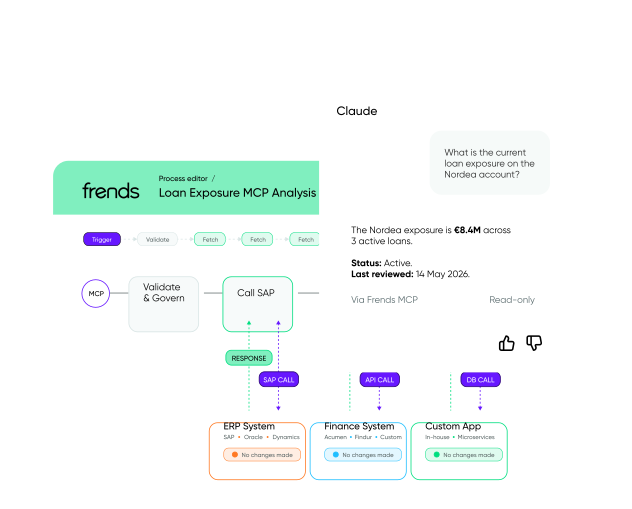
The Enterprise MCP answers all three questions at once. A Frends Process sits in front of the existing system, with no changes to the underlying code, and exposes a specific piece of work as a tool the AI can call: retrieve pending invoices, fetch vendor details, approve or hold an invoice. Claude, ChatGPT or another AI client of your choice reaches the system only through those tools.
Join, filter and business logic run inside the Process, so the AI receives a relevant answer instead of a pile of raw records. Guardrails, data masking, per-identity access controls and time-limited authorizations are configurable at the same layer. Every call maps to a Process instance with full execution logs, which gives you the trail from the first request to the final action.
“We should really consider wrapping all of our systems, especially our legacy and custom systems, into AI-compatible tools,” Asmo said in a webinar.
Start with one simple challenge
Pick one system and one question your team asks it every week. Expose that question as a read-only tool first, let people use it in the AI client they already have, and read the logs to see what they ask. Add the tools that take action, like approvals and updates, once the read-only version has earned trust.
At the Gartner IT Symposium/Xpo in Barcelona, Asmo shows this live on stage: an AI investigating a real ERP, building the connectivity layer with guardrails and executing actions. No pre-recordings. The session is Nov. 11 at 3 p.m. inside the Symposium.
Download the State of Integration & AI 2026 report for the full data behind this article.